Site Information
By · CommentsWelcome to the latest addition to the web presence of North Atlantic Canoe and Kayak. This site is organized as a Web Log or “blog” for short. It enables us to post information as soon as it becomes available and allows you to interact by posting comments. You can even subscribe by email to keep up with the latest posts and comments. And if you’re looking for something specific the postings and other materials are now fully searchable in several ways. Check out the Site Information link for details. Enjoy your visit.
The members’ only area requires a password to enter. If you are a current NACK member and need a password please contact the webmaster@get-the-nack.org
US Coast Guard Contact Numbers
By · CommentsColin contacted the U.S. Coast Guard and requested the phone numbers for the stations responsible for search and rescue on Long Island and Connecticut waters. It might be a good idea to place the ones for the area you paddle in your cell phones contact file. Below is their response to his request.
Mr. Mullen,
Thank you for your inquiry.
Below are a list of our stations and their contact numbers:
New London (860) 442-4471
New Haven (203) 988-4323
Kings Point (516) 466-7135
Eaton’s Neck (631) 261-6959
Jones Beach (516) 785-2995
Fire Island (631) 661-9101
Shinnecock (631) 728-0343
Montauk (631) 668-2773
Please advise your club members that cell phone service is very unreliable on the water. A VHF radio is an essential piece of paddler emergency equipment that could save one’s life.
Best Regards,
Petty Officer Erik Swanson, PA2
U.S. Coast Guard/DHS
Public Affairs Detachment New York
1 South St. New York, NY 10004
NACK Newsletter 2012 Edition
By · CommentsThe latest NACK Newsletter, the Winter 2012 Edition is now available. Check out the Winter Pool Program, Gliding Through Summer and Winter, Cold Water Peer Practice, Revised Paddling Trip Guidelines, Reflections from the Cockpit, and Build Your Own Kayak.
Happy New Year Everyone!!!
NACK Paddlers Rescue Sailors in Distress
By · CommentsNACK paddlers Colin Mullen and Dara Fee are featured in the December issue of Sea Kayaker magazine for their recent rescue of two sail boaters in Peconic Bay. Very briefly, while on a paddling trip, they came across two sailors who had apparently gone overboard, without life vests (PFDs). Neither was able to climb back aboard as their sailboat drifted away dragging its anchor. Colin located one of the sailors in serious distress, quite a distance away, by his faint calls for help. Meanwhile Dara chased down the runaway sailboat and the second sailor. Most of the time we hear of boaters coming to the rescue of paddlers so it is especially gratifying to see those roles reversed. All the details are in the December issue of Sea Kayaker.
NACK Fall Newsletter
By · CommentsThe NACK Fall Newsletter is now available. In this edition: The Presidents Message, Manhattan Circumnavigation, Paddling Skill Levels, GPS Pathfinder or Paperweight? and a review of many recent trips and activities.
NACK Open Meeting Monday 12/12/11
By · CommentsThe next meeting of North Atlantic Canoe and Kayak will feature a presentation by the Coastal Research and Education Society of Long Island. At 7:30 CRESLI will present a photographic tour of the marine mammals, sea turtles, and seabirds of New York waters. Everyone is welcome. The meeting will be held at the Connetquot Public Library 760 Ocean Ave Bohemia, NY 11716
Our regular meeting will begin at 7PM with the usual pre-meeting gathering at 6.
Last weekend NACK members had the opportunity to visit the facilities of the Riverhead Foundation where they attended a lecture on Sea Turtles and Marine Mammal Strandings. After the lecture we got a private of tour their rehabilitation center and laboratory area. Every year the Foundation helps rescue seals, dolphins and sea turtles that are injured or in the case of sea turtles, stranded in our waters by the rapid onset of cold weather. They also conduct research, often attaching GPS tracking devices on released animals to monitor their activities.
Kayakers are often a position to find animals in distress and the Riverhead Foundation maintains a 24 hour emergency response team for all of Long Island and NYC. So if you find an animal in distress please contact the Riverhead Foundation at 631 369 9840. They also point out that sea turtles, which are commonly found at this time of year, may be in such a state of cold shock stunning that they may appear dead. Their heart rate and respiration slow down severely but they can often be saved if you contact the foundation.
On this Thursday November 17, 2011 the Foundation, in cooperation with the Town of Hempstead Department of Conservation and Waterways, will present a free seminar on marine mammals and sea turtles. The seminar will also show residents what to do if a seal, dolphin, whale or sea turtle is stranded on the beach. It will begin at 6PM at the Administration Building on Lido Boulevard in Point Lookout.
Reservations are required by calling the foundation 631 369 9840 or emailing volunteers@riverheadfoundation.org
The Riverhead Foundation is located on the Peconic River in Riverhead adjacent to Atlantis Marine World.
Nissequogue River Kayak Accident
By · CommentsA tragic kayak accident Friday took the life of a Smithtown man but spared the life of his 5 year old son. According to published reports, they had launched a Sea Eagle inflatable kayak into the Nissequogue river in Kings Park at 1:30. Around 2:45 the 5 year old, who was wearing a life vest, was found drifting in Smithtown Bay by a passing boater. Their kayak was floating about 500 yards off the beach with no sign of the father. His body was recovered the next day over a mile out in the bay. What exactly happened that put them in the water is unknown.
What we do know is current in that area runs especially hard since the river level drops over seven feet on the ebb tide. To make matters worse Friday was a full moon spring tide. With high tide at 11 AM the current flow out of the river was probably at the maximum about the time they launched. And according to reports the deceased was not wearing a life vest.
The various media have extensively portrayed the human side of this incident and it’s toll on the family and community. While this was a tragedy, and our sincerest condolences are extended to the family, there are some lessons to be learned.
For one, it underscores the importance of wearing a personal floatation device (PFD). The five year old survived only because he was wearing a PFD. From November to May NYS requires that adults in small craft wear PFDs. During the warmer months NYS law only requires adults to have a PFD but doesn’t require that it be worn. Unfortunately, if you find yourself in the water, you will quickly discover that it is just about impossible to put it on. And while you struggle to get it on even the slightest breeze will push your kayak away faster then you can swim. Then what?
Paddling alone is also not a good idea. With a partner if you encounter some difficulty at least there will be someone there to help. You need to understand the nature of your craft to evaluate it’s sea worthiness in a variety of conditions. And you need to understand the forces at work with wind and the rise and fall of tides. Finally you need to ask yourself “Is my level of skill appropriate for the conditions I may encounter?” Which leads us to the need for proper instruction. No one is born a kayaker. And no one knows what they don’t know.
Sea Kayaker magazine has published a book that examines a number of kayak accidents for the purpose of educating paddlers. It is not intended to be judgmental in that it doesn’t “blame the victim” but seeks to help us understand mistakes so others avoid problems while paddling.
From the back cover:
Sea Kayaker magazine reports on accidents and near accidents so its readers might learn from the experience of others rather than having to learn the hard way. Sea Kayaker’s Deep Trouble gathers more than twenty of the most compelling and instructive of these reports, outlining the circumstances of each accident and providing detailed analyses: What did the paddlers do wrong? What did they do right? Most importantly, how might the accident have been prevented? With a comprehensive introduction to kayaking safety and three dozen sidebars on gear, skills, and techniques, this book is a must for any sea kayaker who wants to paddle safely.
Sea Kayaker Deep Trouble is vailable at many local kayak shops and the usual online sources. At about $15 it’s well worth the investment.
NACK Paddlers Kayak Around Manhattan Island
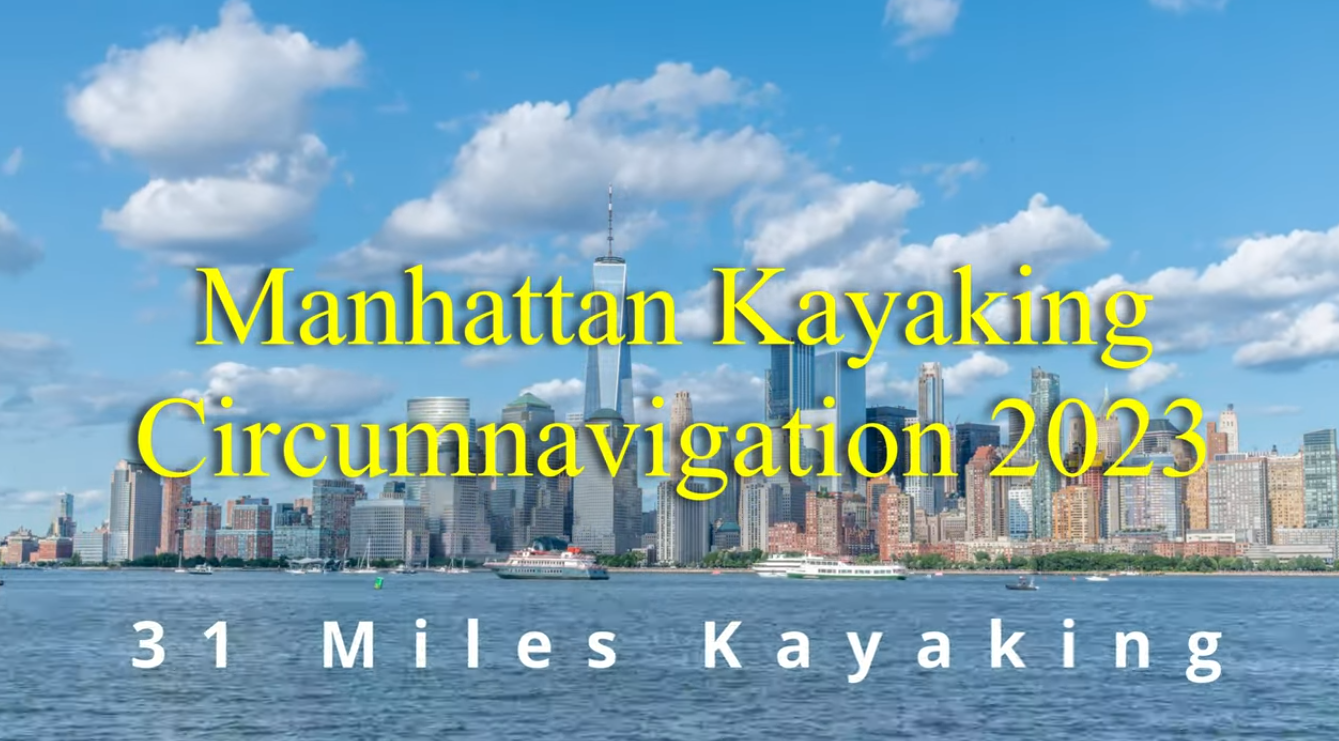
By · CommentsEight NACK Members and a couple of friends met up with the Yonkers Paddling and Rowing Club on Saturday 7/16/2011 for their Kayak Around Manhattan event. The Manhattan Island kayak circumnavigation began at Pier 40 (Houston Street) and launched from the Downtown Boathouse floating dock.
Circumnavigating Manhattan in a kayak is a tricky 30 mile trip that requires careful planning and timing to make the most of the strong currents and avoid getting caught paddling against the flow.
As we got underway the Manhattan skyline was stunning in the early morning sun. In short order the Statue of Liberty was visible on our right as we approached the Staten Island Ferry terminal. There’s plenty of big commercial boat traffic and pleasure craft in the area so it’s essential that the group stay well organized. Carefully coordinating the crossing of the Battery on VHF radios we made it to the Brooklyn side of the East River and the magnificent Brooklyn Bridge.
Perhaps the most critical part of the trip is passing thru the Hell Gate confluence of the East River, Harlem River and Long Island Sound. With the full moon the day before, currents in the vicinity were running up to six knots. Paddling up the East side of Roosevelt Island we were traveling at 10 MPH on the GPS and we sought shelter in Hallet’s Cove to await the slack at Hell Gate.
After about an hour layover we made a quick dash past Mill Rock and across Hell Gate to the Harlem river. There’s only a brief window of opportunity to get it done before the East River begins to flow south and the Harlem River flows north as water rushes in from Long Island Sound.
Our trip up the Harlem River took us past the old landmark Macombs Dam Bridge and Yankee Stadium.
The second scheduled stop was the Peter Jay Sharpe boathouse in Swindlers Cove on the Harlem River. It’s an absolutely beautiful location; hard to imagine that you’re in the heart of the city.
After a quick lunch we again headed north with the current on the Harlem River, past Columbia Rock to where the river meets the Hudson. This is another “interesting” location where the north flow of the Harlem River meets the south flow of the Hudson. However passing by the swing bridge at Spyten Dyvil was uneventful in spite of the somewhat confused water.
Heading down the Hudson, passing under the George Washington Bridge, we again took advantage of the strong current in mid river. The GPS read over 6 MPH most of the way while we paddled at a fairly leisurely pace. Approaching Grant’s Tomb however, the wind that had turned to the south and building began to work against the tidal flow of the Hudson. In a classic wind-against-tide situation swells quickly grew to 2 to 3 feet and were closely spaced.
By mid afternoon the NOAA Weather Station at Robbins Reef, directly to our south, was reporting wind SSW at 15 to 17 knots. Since it was blowing directly up river, there was almost 17 miles of open water for that wind to try to push water back up the Hudson. The river, flowing at about 3 knots, of course refused to be held back and treated us to a pretty good roller coaster ride. The group hung together and then took a brief rest at Pier 96 while a big cruise ship departed. Then, rested and refreshed, we continued three more miles back to Pier 40 where, at 5 PM, a tired group of paddlers congratulated one another on their accomplishment.
The kayak circumnavigation of Manhattan Island is certainly a trip that one will long remember. Many thanks to the YPRC, Steve Blumling, Jerry Blackstone and all the fellow paddlers for a safe and enjoyable day.
Trip Total 30.2 Miles Average speed 4.5 MPH. Paddlers: John Weickert, Debbie Horne, Colin Mullen, Dara Fee, Ron Herrman, Renee Levine, Steve Mcdonald, Buddy Ficarelli, Wayne Seroka, and Carl Thor
Lots more photos Click Here with special thanks to David Gottleib, Dara Fee, and John Weickert for their photos.